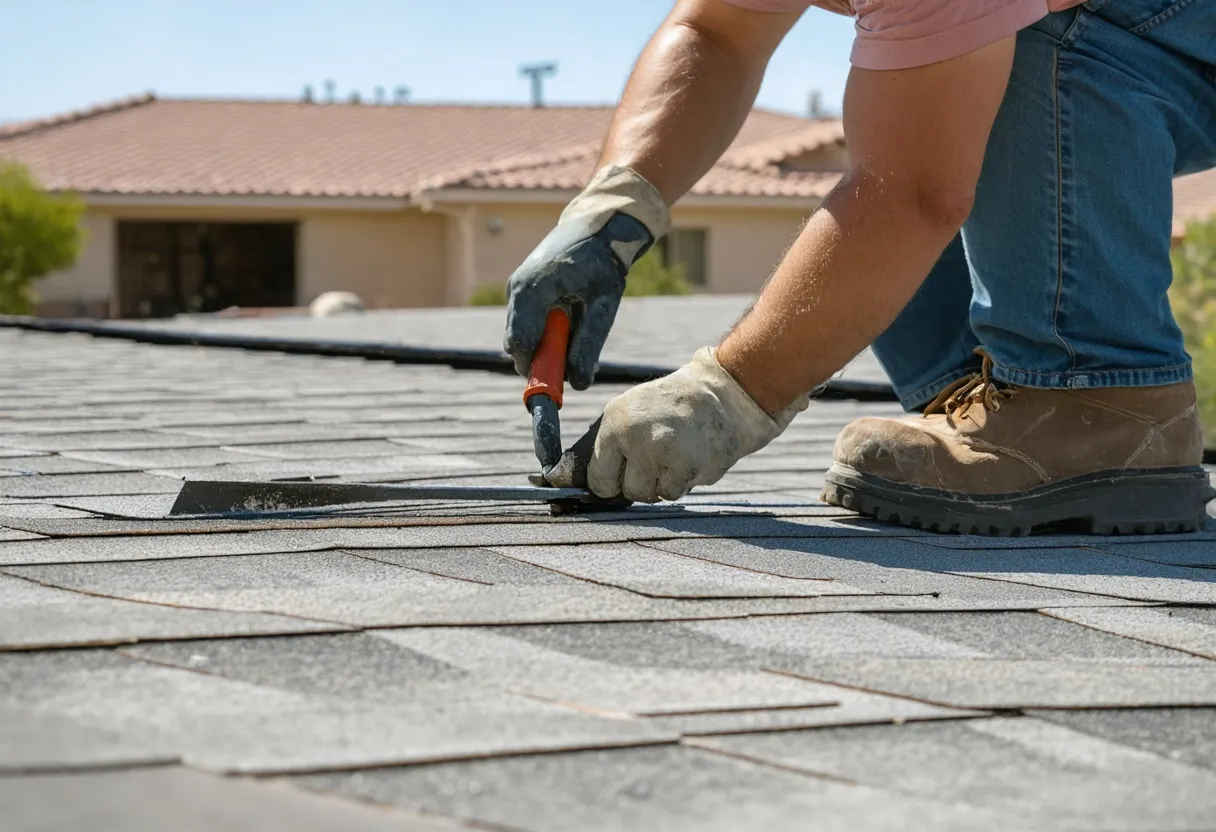
Glendale roofs do a specific job most manufacturers never actually test for: baking under sustained, intense summer sun for months, then taking a direct hit from a monsoon microburst a few hours later. That heat-cycling and wind-driven-rain combination is why the same handful of questions come up on almost every call we take — from a homeowner near State Farm Stadium checking on a few slipped tiles, to a family in the 85308 zip code wondering whether a stubborn attic stain means a small patch or a full tear-off, to someone in Peoria trying to figure out what an insurance adjuster will actually want to see. This page collects those recurring questions and answers them plainly, organized the way Glendale homeowners actually ask them: what's urgent versus what can wait, what a replacement really involves day to day, what your warranty covers and doesn't, how to document storm damage before you file a claim, and what the City of Glendale expects before a crew ever touches your roof.
Every answer here reflects an Arizona climate-tested approach — materials, underlayment choices, and workmanship judged against how tile, shingle, and foam systems actually age in the Valley, not against how they'd perform in a wetter, milder market somewhere else. Pricing and financing terms are laid out upfront during your inspection, in writing, before anything is scheduled, because a homeowner comparing quotes after a storm shouldn't have to guess what a number actually includes or chase down a callback to find out.
Why Arizona Climate-Tested Roofing Matters in Glendale
Roofing crews that mainly work in milder, wetter climates don't always account for how Glendale's specific weather cycle stresses a roof over time. Summers here mean months of sustained, intense UV exposure and daily heat-cycling — the roof deck, flashing, and fasteners expand under afternoon sun and contract again overnight, repeated for a season that runs far longer than in most U.S. markets. Then monsoon season, roughly June through September, layers sudden high wind gusts, driving rain, and occasional hail on top of materials that have already spent months drying out and stiffening in the heat.
That combination is why we evaluate and price tile, shingle, and flat or foam systems specifically for how they perform under Arizona conditions, rather than applying a single generic standard across every roof type. Underlayment selection, flashing detail around vents and skylights, tile fastening method, and foam recoat scheduling are all judged against how they'll hold up through another Glendale summer and monsoon season — not just how the finished roof looks on installation day.
What this means for your roof, specifically
In practice, it means we look harder at underlayment condition on tile roofs than at the tile itself, recommend shorter inspection intervals for shingle roofs than manufacturers' national guidance typically assumes, and build ponding-water resistance into flat and foam roof work rather than treating it as an unlikely edge case.
Repairs, Roof Types & Emergency Questions
An active interior leak, tile that has slid and exposed bare underlayment, shingles that lifted or blew off during a monsoon gust front, and standing water that won't drain off a flat or foam roof are all situations worth addressing quickly rather than waiting for the next open appointment. A single hairline crack in a tile that isn't leaking, or minor granule loss on a shingle roof, usually isn't urgent — but it's still worth a look before the next storm turns a small issue into an active one.
On most Glendale tile roofs, the tile itself is rarely the point of failure — the underlayment beneath it is, and that layer has a noticeably shorter service life than the tile sitting on top of it. A roof with original tile from an older build can look intact from a ladder while the underlayment underneath has already dried out and cracked from years of heat-cycling, quietly setting up a future leak with no visible warning sign. That gap between what tile looks like and what's actually happenin
No — each system fails on its own timeline and needs its own diagnosis. Shingle roofs in Glendale tend to age from sustained UV exposure that dries and curls the tabs until wind can lift an already-weakened edge. Tile roofs usually fail at the underlayment while the visible tile field stays intact. Flat and foam roofs depend on an unbroken, sealed membrane and are most vulnerable to ponding water and a worn-through elastomeric coating that's lost its UV protection. We diagnose and price each sys
Often, yes. If the damage is localized and the deck and underlayment underneath the affected area are still sound, a targeted section repair is a legitimate long-term fix, not just a stall tactic before a bigger sale. We'll tell you plainly during the inspection whether a section repair makes sense for your roof, or whether it's likely to be a short-term patch on a roof that's close enough to the end of its service life that full replacement is the more honest recommendation.
How a Roof Replacement Actually Unfolds
A full walk of the roof itself — not a drive-by or a ground-level guess — checks deck condition, underlayment state, tile or shingle attachment, and flashing at every penetration, resulting in a written, itemized price before anything is scheduled.
Larger-scope work like a full tear-off and replacement is more likely to require a City of Glendale permit than a small, targeted repair, though the exact requirement depends on your specific job; when one applies, we handle the application and inspection scheduling.
Timeframes vary meaningfully by material: a shingle roof on a typical single-family Glendale home generally runs about one to three days, a re-tile with new underlayment often takes three to seven days since much of the existing tile is salvaged and reset, and foam roofing needs dry, stable weather, so scheduling can shift around monsoon season.
Before calling the job finished, we walk the completed roof with you, confirm any required permit inspection has passed, and hand over written manufacturer and workmanship warranty terms so there's a clear record of exactly what's covered.
Insurance Damage Documentation Checklist for Glendale Storms
Roof Warranty Questions Answered
Roofing warranties usually come in two separate pieces, and mixing them up is one of the most common points of confusion we hear from Glendale homeowners after a repair or replacement.
Manufacturer's material warranty
This covers defects in the shingles, tile, foam, or membrane itself, under whatever terms the manufacturer sets. It has nothing to do with how the roof was installed, and it won't help you if a leak traces back to flashing or fastening rather than a defective product.
Workmanship warranty
This is the coverage your contractor provides on the installation itself — flashing, sealing, fastener placement, and general craftsmanship. It's the piece that actually protects you if a leak traces back to how the job was done, and it's specific to whichever contractor performed the work.
Before signing with anyone, ask exactly what each warranty covers, how long it runs, and whether the workmanship warranty transfers if you sell the home — transferability can matter to a future buyer. We put both sets of warranty terms in writing on every job, so there's a clear record to point to instead of a memory of what was said during the estimate visit.
No Pressure, No Guesswork Pricing
Every Glendale quote we provide is itemized and delivered in writing before any work is scheduled, and financing options are discussed with real terms attached — never a vague 'financing available' line with no numbers behind it.
Permits, Licensing & Service Area Questions
It depends on scope. A full roof replacement is more likely to require a permit than a small, targeted repair, but the exact requirement for your project should be confirmed with the City of Glendale building department or your contractor before work starts — treat this as a general pattern to ask about, not a guarantee for your specific job. When a permit does apply, it means an inspector independently checks the finished work against code, which works in your favor as the homeowner rather than
Ask for the contractor's Arizona Registrar of Contractors (ROC) license number and check it directly with the state rather than taking a business card or a verbal claim at face value. A legitimate contractor should hand over that number without hesitation, along with proof of liability insurance and workers' compensation coverage. That verification step is one of the simplest ways to protect yourself from unlicensed or underinsured crews, which tend to show up in Glendale looking for quick work
We work throughout Glendale and the surrounding Northwest Phoenix metro area, including neighborhoods around zip codes 85301 and 85308 and nearby Peoria, AZ. If you're within a few miles of a recognizable landmark like State Farm Stadium, you're almost certainly within our normal service radius — call and describe your location and we can typically confirm coverage in a couple of minutes rather than making you wait for a callback.
If tear-off reveals deck rot or underlayment failure that wasn't visible during the original inspection, we stop work and walk you through exactly what was found, what it adds to the cost, and what your options are before continuing. You won't get a surprise line item on the final invoice without a conversation first — any change to the original itemized quote gets explained and agreed to while the roof is still open.
Get Your Upfront Quote
No pressure, no guesswork — just a clear price for your roof.
Ready for a Roof Built for Arizona?
Reach out for a straightforward, upfront quote.